 Image 1 of 1
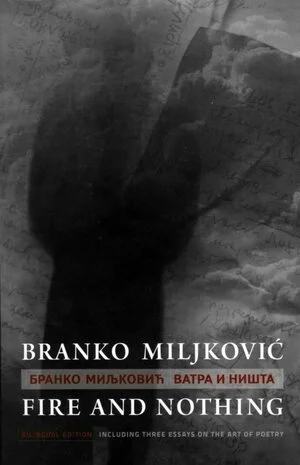
Fire and Nothing, by Branko Miljković (bilingual edition)
170 pages
ISBN: 978-09678893-5-1
Weight: 7.2 ounces
Branko Miljković, one of the greatest Serbian lyric poets of the mid-twentieth century, remains an enigma fifty years after his death. He was born in 1934 near Niš in southern Serbia. His genius, recognized at an early age, matured to write poetry that restored magic and mystery to the world. He cast a spell with the simplest words, created the great drama of being, fire, and nothingness, and invested his verse with unfathomable majesty.
Miljković referred to himself as a Neo-Symbolist, and continued where his mentors left off. Mallarmé, the poet to whom he felt the closest affinity, longed to put the entire world into a single volume of poetry: L'oeuvre, Le Grande Oeuvre, comme disaient les alchimistes, nos ancestres. Since Mallarmé’s Le Grand Oeuvre remained unrealized, Miljković, supremely confident of his vocation, worked with the patience of an alchemist to create l'explication orphique de la Terre, qui est le seul devoir du poete et le jeu litteraire par excellence that Mallarmé had envisioned.
Symbolism and Surrealism had both disappointed Miljković because he believed an important task had been left undone. He prepared to explore terra incognita by synthesizing the two movements, a mad attempt to create a poetic microcosm of the universe by tackling metaphysical themes with concrete imagery, paradox, intuition, and prophetic language.
Miljković did succeed in restoring poetry to the center of communicative discourse. His verse quickly entered the national consciousness, as if his simple, startling words had always existed at the end of the rainbow, but had only just now been spoken for the first time.
Review
Although not fully replicated in the English translation, the translator seems to have done as fair of a job as possible in capturing the essence of Miljković’s lines/symbols without resorting to ossifying the freeness of the original verse with a stilted translation. When I originally wrote this short review back in July on Gogol’s Overcoat (http://gogolsovercoat.com/?p=308), I had only read only about a fifth of the poems. What I said then was that Miljković reminded me favorably of those few poems of Mallarmé that I had read in French or English translation. Having finished the entire collection in the interim, what I can briefly add here is that the second half of the collection is perhaps even stronger than the very good first half. Miljković is not a poet whose imagery and themes can be easily grasped in a single reading; it is doubly difficult when one only reads his native language at an elementary level and the parsing of the bilingual text ends up being halting and hesitant. But sometimes it is worth the effort to wrest meaning and understanding from the text and in the case of Miljković’s poems, the intrepid reader is rewarded for her effort, especially if s/he revisits the collection after an interval and begins almost anew. Vaguely Borghesian (09/11/2012)
About the Author
Branko Miljković was born on January 29, 1934 in Gadžin Han, which lies just outside of Niš in southern Serbia. He began publishing poems in literary reviews when he was sixteen years old. He was studying Philosophy at the University of Belgrade when he published his brilliant first volume of poetry, I Wake Her in Vain (1957), which established his reputation.
Miljković won the prestigious October Prize in 1960 for Fire and Nothing, but renounced his poetry only a few months later. He was found dead on February 11, 1961 in a park on the outskirts of Zagreb. His death was officially declared a suicide by the Croatian police, even though forensic evidence indicated murder. The circumstances of his death are still disputed today.
He was drawn by temperament to the Russian poets Mayakovsky, Blok and Briusov as well as to Mallarmé and the French Surrealists, whose poems he translated.
All the true formulas in the world are poetic. I often look into Einstein's formulas and I believe that they can be translated into verse. Contemporary physics can take a verse of Baudelaire for its epigraph: Man's journey leads through a forest of symbols. My formulation: Words are a mighty framework and vessel for and of the world. Everything that takes place on earth occurs as well in language and symbol, whether it concerns atoms or stars.—Branko Miljković
——————————————————————————
from Consciousness of the Poem
I’m not ashamed of anything anymore.
The sun has set on the world. The desired fruit will erupt
With night. A voice dreaming of itself finds treasure,
A distant wall where my ship has been bricked up.
I guard my pride in that wall, I sing
More beautifully — than I do free — immured.
Where do I get the strength to resist my being,
When vines cannot resist, nor the fertile vineyard!
To live without the self: a strange desire?
To want a poem without a poet? Time,
From the oblivious past, does it admire
The betrayal of my thwarted design?
Does that mean saying to change: Not for
Me! And let the poem change itself? Furthermore
To dedicate myself to beast and flower
And lend my strength to black roots’ hunger?
I’m not ashamed to sing behind a wall
Better in such night than free elsewhere.
The sun stings my heel. The blazing wall
At the end of the road — it leads nowhere.
170 pages
ISBN: 978-09678893-5-1
Weight: 7.2 ounces
Branko Miljković, one of the greatest Serbian lyric poets of the mid-twentieth century, remains an enigma fifty years after his death. He was born in 1934 near Niš in southern Serbia. His genius, recognized at an early age, matured to write poetry that restored magic and mystery to the world. He cast a spell with the simplest words, created the great drama of being, fire, and nothingness, and invested his verse with unfathomable majesty.
Miljković referred to himself as a Neo-Symbolist, and continued where his mentors left off. Mallarmé, the poet to whom he felt the closest affinity, longed to put the entire world into a single volume of poetry: L'oeuvre, Le Grande Oeuvre, comme disaient les alchimistes, nos ancestres. Since Mallarmé’s Le Grand Oeuvre remained unrealized, Miljković, supremely confident of his vocation, worked with the patience of an alchemist to create l'explication orphique de la Terre, qui est le seul devoir du poete et le jeu litteraire par excellence that Mallarmé had envisioned.
Symbolism and Surrealism had both disappointed Miljković because he believed an important task had been left undone. He prepared to explore terra incognita by synthesizing the two movements, a mad attempt to create a poetic microcosm of the universe by tackling metaphysical themes with concrete imagery, paradox, intuition, and prophetic language.
Miljković did succeed in restoring poetry to the center of communicative discourse. His verse quickly entered the national consciousness, as if his simple, startling words had always existed at the end of the rainbow, but had only just now been spoken for the first time.
Review
Although not fully replicated in the English translation, the translator seems to have done as fair of a job as possible in capturing the essence of Miljković’s lines/symbols without resorting to ossifying the freeness of the original verse with a stilted translation. When I originally wrote this short review back in July on Gogol’s Overcoat (http://gogolsovercoat.com/?p=308), I had only read only about a fifth of the poems. What I said then was that Miljković reminded me favorably of those few poems of Mallarmé that I had read in French or English translation. Having finished the entire collection in the interim, what I can briefly add here is that the second half of the collection is perhaps even stronger than the very good first half. Miljković is not a poet whose imagery and themes can be easily grasped in a single reading; it is doubly difficult when one only reads his native language at an elementary level and the parsing of the bilingual text ends up being halting and hesitant. But sometimes it is worth the effort to wrest meaning and understanding from the text and in the case of Miljković’s poems, the intrepid reader is rewarded for her effort, especially if s/he revisits the collection after an interval and begins almost anew. Vaguely Borghesian (09/11/2012)
About the Author
Branko Miljković was born on January 29, 1934 in Gadžin Han, which lies just outside of Niš in southern Serbia. He began publishing poems in literary reviews when he was sixteen years old. He was studying Philosophy at the University of Belgrade when he published his brilliant first volume of poetry, I Wake Her in Vain (1957), which established his reputation.
Miljković won the prestigious October Prize in 1960 for Fire and Nothing, but renounced his poetry only a few months later. He was found dead on February 11, 1961 in a park on the outskirts of Zagreb. His death was officially declared a suicide by the Croatian police, even though forensic evidence indicated murder. The circumstances of his death are still disputed today.
He was drawn by temperament to the Russian poets Mayakovsky, Blok and Briusov as well as to Mallarmé and the French Surrealists, whose poems he translated.
All the true formulas in the world are poetic. I often look into Einstein's formulas and I believe that they can be translated into verse. Contemporary physics can take a verse of Baudelaire for its epigraph: Man's journey leads through a forest of symbols. My formulation: Words are a mighty framework and vessel for and of the world. Everything that takes place on earth occurs as well in language and symbol, whether it concerns atoms or stars.—Branko Miljković
——————————————————————————
from Consciousness of the Poem
I’m not ashamed of anything anymore.
The sun has set on the world. The desired fruit will erupt
With night. A voice dreaming of itself finds treasure,
A distant wall where my ship has been bricked up.
I guard my pride in that wall, I sing
More beautifully — than I do free — immured.
Where do I get the strength to resist my being,
When vines cannot resist, nor the fertile vineyard!
To live without the self: a strange desire?
To want a poem without a poet? Time,
From the oblivious past, does it admire
The betrayal of my thwarted design?
Does that mean saying to change: Not for
Me! And let the poem change itself? Furthermore
To dedicate myself to beast and flower
And lend my strength to black roots’ hunger?
I’m not ashamed to sing behind a wall
Better in such night than free elsewhere.
The sun stings my heel. The blazing wall
At the end of the road — it leads nowhere.