 Image 1 of 1
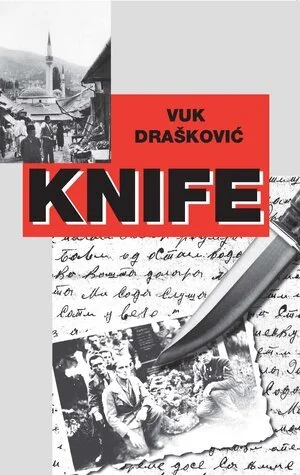
Knife, by Vuk Drašković
440 pages
ISBN: 978-09678893-6-8
Weight: 1.33 pounds
When Alija Osmanović, a Bosnian war orphan who is the protagonist of Knife, goes in search of the identity of his murdered birth-parents, a sense of thwarted justice motivates him, and expresses itself as burning passion for revenge. This is summed up by the novel's title.
The opening chapter describes the massacre of a Serbian village by Muslim Ustaše on Christmas Day (January 7) of 1942. The sole survivor is a newborn male infant, spared at the last moment and given to a Muslim woman who lost her husband in the raid. The boy is named Alija, and is raised as a Muslim, and later comes to believe that his family was killed by Serbs. Twenty-one years later, Alija, now a medical student in Sarajevo, discovers that the newspapers are interested in his story. An article about him is published in a Sarajevo daily, and he begins receiving mail. Most of it is sympathetic but unhelpful, although he does receive an enigmatic letter which reads: You are certainly not what you are, nevertheless, you are what you are not. Alija seeks out Sikter Effendi, an eccentric and reclusive Muslim cleric, to help him interpret the enigma. Sikter Effendi, an irascible outsider, is, nevertheless, considered to be honest, because he has suffered at the hands of each regime: Ustaše as well as Communist. He has responded by developing a fine sense of disgust for the human race, and he steeps himself in history, trying to untangle the threads of misfortune. But when Alija enters the Effendi’s life, a transformation occurs. Sikter Effendi finds a spiritual heir. Through Sikter Effendi s mentorship, Alija discovers the truth: that his heritage is Serbian; that he was born not far away but in the neighboring village; and that his adoptive family was guilty of murdering his birth-family. A crisis of identity ensues. Each possible course of action open to him is bad. How is he to go on?
Review
Knife is an ambitious political melodrama that explores the conflicted psyches of two protagonists bent on revenge against their parents' murderers: student Alija Osmanović, who discovers he shares a troubling kinship with those he considers his bitterest enemies; and Milan Vilenjak, the Javert-like pursuer of a despicable war criminal, Atif Tanović, who to Milan’s frustration, proves a man of conscience and a genuine penitent. The story ... has real power — and the complex, suffering figure of Tanović has an almost Dostoyevskian intensity. A fine start for SCP [The Serbian Classics Press], and a hopeful indication that more of the literature of the Balkan countries may be reaching us soon.
—Kirkus Reviews July 15, 2000
About the Author
Vuk Drašković is Serbia's most controversial novelist. Knife (1982), his second novel, was banned by Communist authorities. Drašković abandoned literature in the early 1990s to form an opposition political party called The Serbian Renewal Movement to introduce democracy to Yugoslavia. He served briefly as Deputy Minister of Foreign Affairs from January until April 1999, when he was dismissed for suggesting that UN troops could monitor a peace agreement in Kosovo. He survived an assassination attempt in October 1999 in which four of his aides were killed. He also served as Serbia's Minister of Foreign Affairs (2003–2007).
Knife is the first of Drašković’s novels to appear in English.
440 pages
ISBN: 978-09678893-6-8
Weight: 1.33 pounds
When Alija Osmanović, a Bosnian war orphan who is the protagonist of Knife, goes in search of the identity of his murdered birth-parents, a sense of thwarted justice motivates him, and expresses itself as burning passion for revenge. This is summed up by the novel's title.
The opening chapter describes the massacre of a Serbian village by Muslim Ustaše on Christmas Day (January 7) of 1942. The sole survivor is a newborn male infant, spared at the last moment and given to a Muslim woman who lost her husband in the raid. The boy is named Alija, and is raised as a Muslim, and later comes to believe that his family was killed by Serbs. Twenty-one years later, Alija, now a medical student in Sarajevo, discovers that the newspapers are interested in his story. An article about him is published in a Sarajevo daily, and he begins receiving mail. Most of it is sympathetic but unhelpful, although he does receive an enigmatic letter which reads: You are certainly not what you are, nevertheless, you are what you are not. Alija seeks out Sikter Effendi, an eccentric and reclusive Muslim cleric, to help him interpret the enigma. Sikter Effendi, an irascible outsider, is, nevertheless, considered to be honest, because he has suffered at the hands of each regime: Ustaše as well as Communist. He has responded by developing a fine sense of disgust for the human race, and he steeps himself in history, trying to untangle the threads of misfortune. But when Alija enters the Effendi’s life, a transformation occurs. Sikter Effendi finds a spiritual heir. Through Sikter Effendi s mentorship, Alija discovers the truth: that his heritage is Serbian; that he was born not far away but in the neighboring village; and that his adoptive family was guilty of murdering his birth-family. A crisis of identity ensues. Each possible course of action open to him is bad. How is he to go on?
Review
Knife is an ambitious political melodrama that explores the conflicted psyches of two protagonists bent on revenge against their parents' murderers: student Alija Osmanović, who discovers he shares a troubling kinship with those he considers his bitterest enemies; and Milan Vilenjak, the Javert-like pursuer of a despicable war criminal, Atif Tanović, who to Milan’s frustration, proves a man of conscience and a genuine penitent. The story ... has real power — and the complex, suffering figure of Tanović has an almost Dostoyevskian intensity. A fine start for SCP [The Serbian Classics Press], and a hopeful indication that more of the literature of the Balkan countries may be reaching us soon.
—Kirkus Reviews July 15, 2000
About the Author
Vuk Drašković is Serbia's most controversial novelist. Knife (1982), his second novel, was banned by Communist authorities. Drašković abandoned literature in the early 1990s to form an opposition political party called The Serbian Renewal Movement to introduce democracy to Yugoslavia. He served briefly as Deputy Minister of Foreign Affairs from January until April 1999, when he was dismissed for suggesting that UN troops could monitor a peace agreement in Kosovo. He survived an assassination attempt in October 1999 in which four of his aides were killed. He also served as Serbia's Minister of Foreign Affairs (2003–2007).
Knife is the first of Drašković’s novels to appear in English.